Field notes
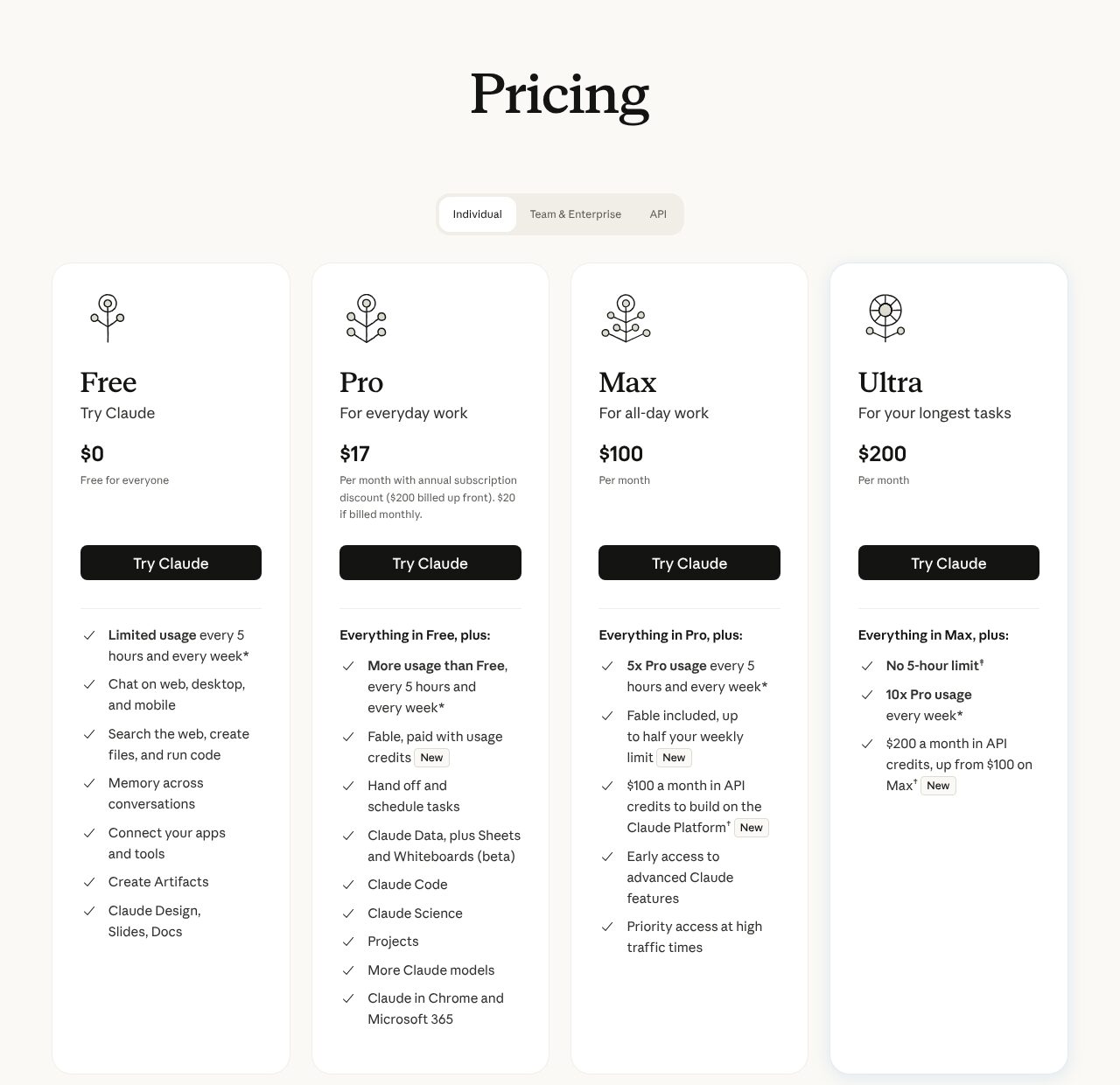
The best AI subscription at $0, $20, $100, and $200 a month
· 19 min read
AI Rabbit Holes · Claude · ChatGPT · Meta Muse · AI Tools · OpenRouter · Hermes Agent
These new personal assistant apps are really cool, and they seem like the future. They're also hard to use more than one at a time. So besides what plan should I pay for, you're getting forced to pick: am I on a GPT subscription, so I have to use dots? Or am I on a Claude Max plan, so I have to use Duet for that always-on assistant?
They ping you, they're proactive, and there are a lot of cool things about them. By their very nature, they're annoying to use more than one. So you have to pick your ecosystem based on more than which models you like.
I went through the best AI subscription at every price with Ryan Doser on AI Rabbit Holes, recorded November 18, 2026. Between the two of us, we pay for about 90% of the plans out there. Our episodes go up on Ryan's YouTube channel, in the AI Rabbit Holes playlist. It follows our episodes on picking an AI personal assistant and the Claude ecosystem.
What Ryan and I pay for
Watch this part of the episode (2:34)
Ryan started with his own stack. He's on the $200 Claude Ultra plan as his daily driver for Claude Code and Duet. He pays $100 a month for ChatGPT Pro, mostly for Codex, image generation, and having it check his work behind the scenes. He pays $20 for Google AI Pro, mostly for the storage, plus OpenRouter at under $20 a month and Cloudflare Workers at $5.
Let's start with Claude. Here's what I tell people: there's no extra multiple going to the $200 Ultra plan. It's just double what you get with $100. I'm on $100. Since Fable 5.2 came out, I usually hit my limits, because it's pretty token hungry. Start with that one. You can always re-up to $200. There's no benefit to going $200 unless you're a power user who cranks on this all day.
I'm flipped from Ryan on Claude and OpenAI. I have the $200 GPT Pro plan, and I have very mixed feelings. Their models are nowhere near Opus. I've used GPT-6.2 Astra on Ultra since it came out, and it doesn't feel any different. I don't agree with everybody saying it sucks.
GPT is really good at computer use and browser use, so it has these weird niches. You get basically unlimited image generation and unlimited chat. It still has its uses, but the Claude plan at $100 is good enough for me.
Google is the same thing for me as it is for Ryan. I need the Drive storage, because I put a lot of video in there. I barely use Gemini. I just started using the new models this week. My OpenRouter is bursty. Sometimes I run things on it, sometimes I don't. I'm on a Cloudflare Workers plan, and I buy my domains there.
I'd add a couple of subscriptions to Ryan's list:
- Meta Muse at $16 a month. I pay with my own money, it's not a gift. I tell everybody who will listen it's by far the best value. If you're using all of that in a week, you're running crazy heavy automations. You're probably trying to burn the rate limits. I don't know how anyone subscribes to a higher tier than that.
- Cursor Ultra and Grok Super Heavy. I love the products, the interface, and the tools. The models suck, and it's not worth it. If you're looking for a new subscription today, there's no reason to get Grok until the model improves.
The best free AI plan
Watch this part of the episode (6:25)
Ryan's ranking for free plans from the frontier labs: Meta Muse first, ChatGPT second, Gemini third, Claude fourth. He pointed out Meta is very generous on free because we're feeding its ad network, and he thinks Anthropic's free plan is the worst.
Gemini changed its free plan the day before we recorded. Everybody gets the new model. I hate the naming, but I think it's Hydrogen, which is basically what used to be Flash. Even a student on a school Google account gets it. So I think Gemini took a step up.
At the top, hands down, it's Meta Muse. I know multiple normal people, not developers, who are on a free Meta Muse plan. The Spark model is fast and conversational, and it has tons of usage unless you're plugging in automations and coding a bunch. Most people don't even need to pay for it. You don't get the best model, but it's still pretty good.
If you're just chatting, GPT is a good deal. When you want the best image model and Codex and real work, none of the free plans are great for that. They're good at sucking you into paying, I think.
Ryan asked if the $5 to $8 plans like ChatGPT Go are even worth it. I don't know anybody on one. If you're going to pay, you might as well pay for something you can use. It's like the kiddie ice cream cone. If you want ice cream, get the small. Don't get the tiny kiddie one.
The best $20 AI plan
Watch this part of the episode (8:49)
Ryan thinks the $20 plans are the ones most people listening to our show care about. From his experience, ChatGPT Plus is the best bang for your buck at $20, because you get way more usage than on Claude Pro or Google AI Pro. Out of those three, he'd go ChatGPT, then Claude, then Gemini.
I'd say it depends on who you are. If you're a normal user, I'd go Meta Muse for $16. I've been paying for it for two weeks now. It's spectacular.
What GPT does better is the ecosystem: image generation and voice models. You don't get dots, but honestly, dots is terrible. I turned mine off the morning we recorded. I'm ready to unplug it.
What you can do with GPT Plus is run really efficient models. If you're doing actual work like websites, landing pages, or video editing, their Terra model is really efficient. The new GPT-6.2 Astra and Sol are way more efficient too. I don't think they're better, but they give you more bang for your buck on the lower tier plans.
You can do a lot of work with a faster, cheaper model on GPT Plus. If it's not just a chat interface and consumer stuff, I'd go GPT. For the average person, I still think Meta Muse is the best play.
I haven't touched Perplexity in over a year, and I don't know anyone else who does. Ryan thinks they have no moat anymore and should have sold when they had the chance. They're reselling tokens for other people's models. If I want something to control my computer, I'm going to use Codex. I don't need Perplexity selling me OpenAI tokens.
The only reason to get the Grok plan is if you're chronically on X and want to bundle it with something. You're stuck with the Grok models, and they're not better than GPT's models right now. I don't see any reason to get that sub.
The best $100 AI plan
Watch this part of the episode (12:03)
At $100, Ryan goes Claude Max every day. He loves the outputs from Opus 5.5 for marketing work, content creation, copywriting, and knowledge work. He said you get way more usage than the $20 plan, $100 in API credits, and a very usable Claude Duet. His longer comparison is on his site: ChatGPT Pro vs Claude Max.
ChatGPT Pro is his number two if you're a power user of Codex. He doesn't think dots or the $100 Google AI Ultra plan are worth it. On his $20 Google plan, he got three or four prompts on Argon 4 before his usage ran out.
I'm on the $100 Claude Max plan, and I tell people it's the best $100 a month I spend. It's as useful to me as my internet bill or my cell phone bill.
The only reason you might go GPT Pro, which I'm also on, is image generation, computer use, and browser use. There are some cool things with connectors and plugins, but for getting real work done and for usage, the Claude Max plan is very generous and the models are better. Their always-on agent, Duet, is 10 times better than dots, even though it's newer. From what I see, it's only going to pull further ahead in the short term.
Ryan didn't know there was a $100 Muse Maximum plan. I don't know who would need it. If you're coding, Meta has a coding plan that's different from Muse. Go to $16 a month, and I bet you can do anything you want on theirs.
With Grok, I don't see any reason to get that plan. I have the $200 plan, which I got in a year bundle. I would never buy it today based on where their models and their rate limits are.
I just got on a Google AI Ultra plan. I used Carbon the night before we recorded, on a little personal benchmark. Ryan taught me this: have your own test, repeat it on all these models, and look at them side by side.
My first response on Carbon was really good and really slow. Overnight I could let it run, maybe. If I was trying to work with it, it was brutally slow. That was my first time using it, but again, there's no reason to get the Google plan. I think $20 a month for storage is their best deal.
Ryan agreed that storage is underrated if you do content creation. I pay for YouTube Premium too, so maybe there's a way to bundle things you already pay for.
The best $200 AI plan
Watch this part of the episode (16:04)
Ryan is on Claude Ultra at $200 a month as his daily driver. He calls it the best investment he's made and keeps making every month, for 10 times the usage, Fable, and no five-hour cap. If you're going to spend $200 a month on one plan, he thinks it's Claude all day for most people doing knowledge work, content, and marketing.
He thinks ChatGPT Pro at $200 still gets a power user a lot of bang for the buck, because the GPT models are more than good enough for most tasks. He hasn't tried Perplexity Max, he'd stay far away from X Ultra, and he could only see Google AI Ultra at $200 for a Gemini power user.
Hard agree. I think the only reason for the GPT $200 or $500 a month plan is if you want maximum efficiency. If you can use Terra and some of their lower tier models, there are ways to get it just humming, and it barely touches your rate limits.
The only other advantage I see is they give you resets. It's kind of like your drug dealer giving you free samples to get you hooked. Claude is doing that more. I think Ryan got three resets when they released Fable, and I got two or three. But with GPT, you'll log in thinking you're low on rate limits, and they just reset. Unless you're on Twitter, you'd have no idea, because it's part of their marketing.
So if you want to maximize total usage, maybe there's a way to justify GPT Pro. But I'm with Ryan. Go Claude.
I don't know anything about Perplexity's Max plan. I don't think either of us knows anyone who's on it. There's no way the Grok one is worth it. Until their models catch up to even OpenAI's models, why would you lock yourself into the Grok ecosystem?
The only thing I could say for Google is if you do a ton with their video generation, their images, and the multimedia part. Maybe there's a way to justify it if you're cool with being locked into their Carbon, Argon, Hydrogen, weird periodic table models. They're not better than Anthropic's, and they're not better on rate limits. Flow is their video editing tool. I don't know anyone who uses it. It's kind of new and kind of niche.
If I could only pick one, I'd go Claude every day of the week.
Why doesn't Google have a personal assistant?
Watch this part of the episode (19:32)
Ryan's question: how are Google's Nano Banana image models and Veo video models not better than OpenAI's image model or Seedance, with all the data they get from YouTube and all their talent and infrastructure?
What's weird is they don't seem to be trying. Nano Banana has been quiet. Same with Veo. I have an even more perplexing one. How do they not have an always-on personal assistant? We all use Google for email, Drive, and calendar. It knows what we ordered off Amazon and who we're meeting with this afternoon. They have the data moat for "here's your schedule today, want me to do this for you?"
How are dots and Duet and Grok Bot and all these little personal assistants ahead of Google? Google has barely tried. They had Spark, they rebranded it as Tasks, and they already had a feature called Tasks. Guys, you have such an advantage. Their fast daily driver model, Gemini 4 Hydrogen, would be good for this. It's solid and pretty quick. How do you not have a Gemini personal assistant app and a good desktop app?
Ryan thinks Google should go after the Meta Muse market, not dots, Duet, or Grok Bot. Google has more distribution than Meta: Search, YouTube, Chrome, and Android, the biggest distribution moat in history.
Just put your cheap Spark-type model on it and make it unlimited. They also have Pixel phones, watches, Pixel Buds, and glasses coming next year with Samsung. It's not as good a hardware moat as Apple and Meta have, but it's only getting bigger, and it doesn't seem like they're trying. Non-technical people want the easy, relatable, safe version of an OpenClaw. Google should have been working on this nine months ago.
Skip the subscription: pay per use
Watch this part of the episode (22:35)
Ryan pointed out you don't have to be locked into a subscription. You can pay as you go through a middleman like OpenRouter, which gets you access to over 600 models, or pull API keys from the official consoles. He thinks OpenRouter is a great spot for people who aren't hardcore power users.
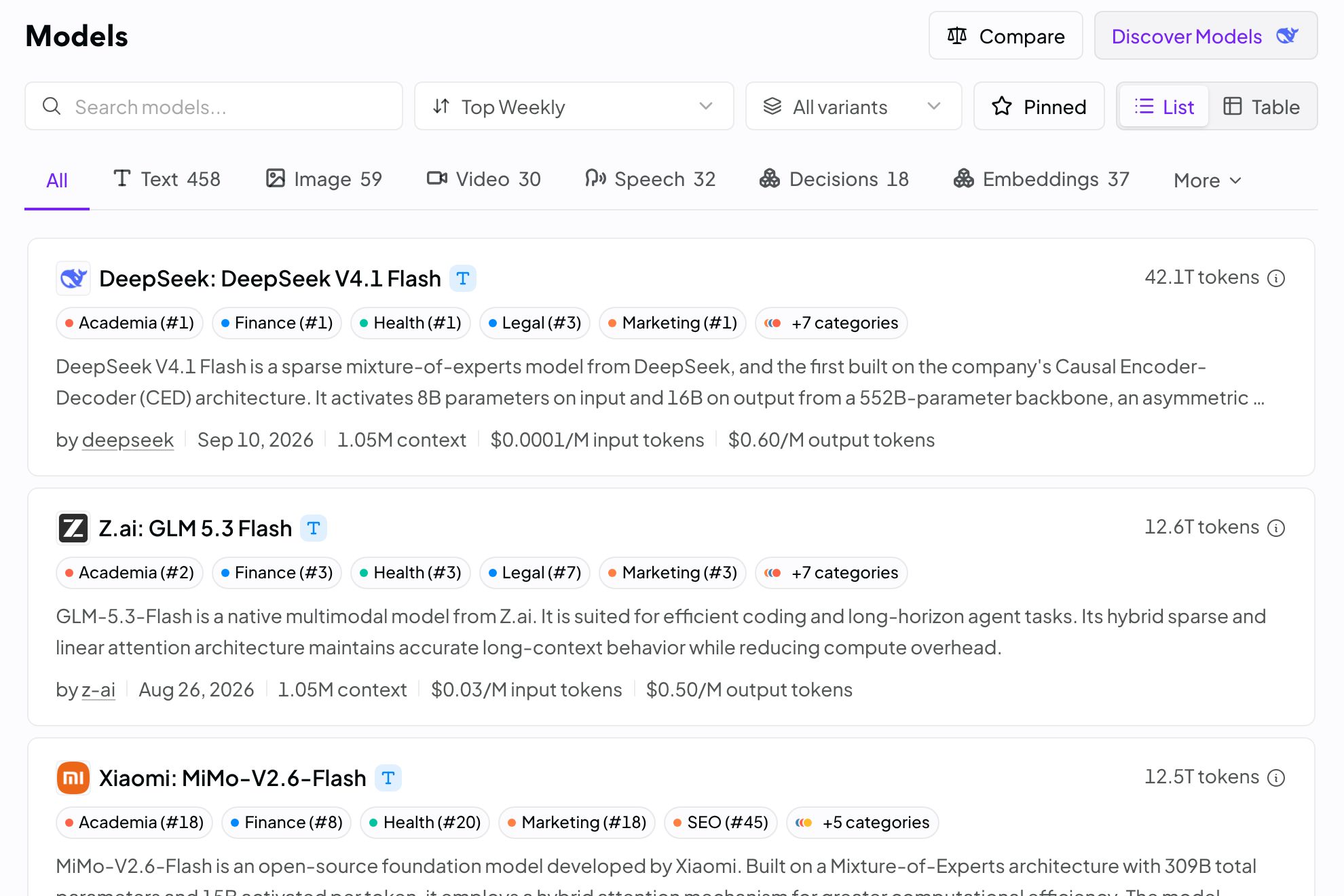
Where to use an OpenRouter API key
Watch this part of the episode (23:33)
I agree with Ryan, but the problem is most people go, what do I plug this into? Say I put $20 on an OpenRouter key, which I do often. I can't open the Claude desktop app or Grok Bot and power it with that API key, because those are locked platforms. So I asked Ryan: if I want to try DeepSeek or GLM for a week, one of these fast, super cheap Chinese models, what app am I in?
Ryan uses OpenRouter for this, because he doesn't trust signing up and giving payment information to the model labs directly. With OpenRouter, he plugs it into OpenCode, a free alternative to Claude Code or Codex, even after its recent hack. Cursor and other IDEs work too.
I'm going to say you should try Hermes. It's as technical as you want it to be. If you want to go full OpenClaw craziness, you can. Most people don't want that. I definitely don't. If you want a desktop app where you can plug in any model, any subscription, or any API key, it does that.
Their iOS and Android apps are coming out of beta. I have the iPhone app because I was a TestFlight user before they hit 10,000 people. You can also hook it up to Discord or Telegram.
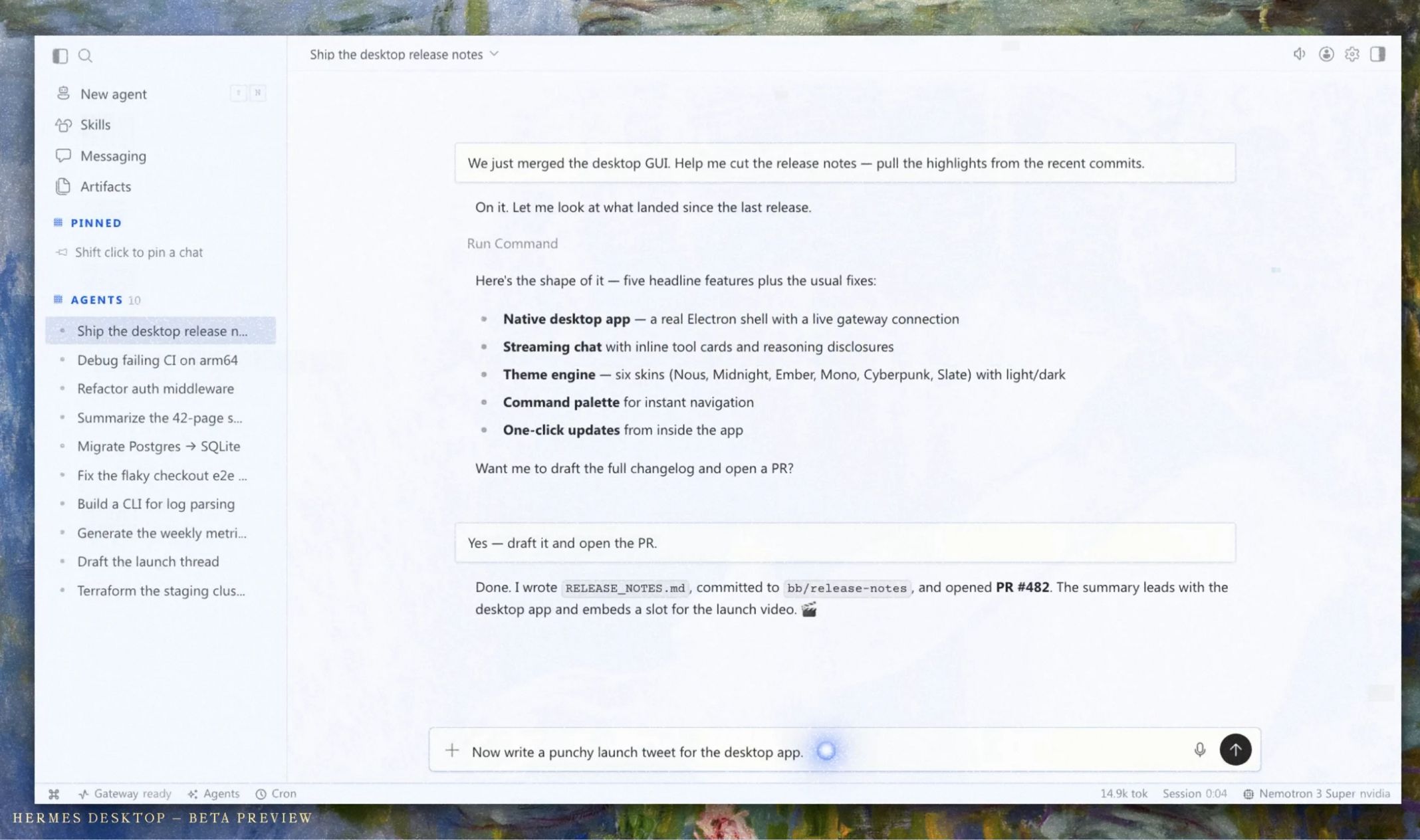
I think Hermes is the most portable, and I say this all the time: it's an insurance policy. If Claude nerfed all their models and I had to go somewhere else, I'd take my subscriptions into Hermes. That's why Grok Bot is not a good tool. When they nerf the rate limits and you're stuck on their model, there's nothing you can do but cancel.
We did a hardware project at home with DeepSeek Flash, coding for about an hour. It was ultra fast. I looked at the cost, and it was 30 or 40 cents. It's not amazing, and I'm not doing video editing or landing pages with it, but for basic stuff it's super fast and solid. You just need a place to plug it in.
Another open source one is Goose. I don't use it a ton, but it's a CLI tool, and you can plug in any API key: here's my OpenRouter, call DeepSeek.
Ryan says don't sleep on DeepSeek. Their models keep improving behind the scenes. They also open sourced a harness. I haven't used it, but I know a few people who do. If you want your own version of a Grok Bot or a Meta Muse type agent, there's a desktop app and a web app called the DeepSeek Harness, and you can plug in any model. If anybody's used it, let me know. Ryan's caution is data privacy. More in our open source AI models episode.
Which other AI subscriptions are worth it?
Watch this part of the episode (27:58)
Ryan's take: ElevenLabs, HeyGen, and Suno still have a moat. Midjourney, Gamma, Lovable, and Higgsfield don't. He could see a use case for Opus Clip.
Let's start with what I'd cross off the list:
- Lovable. I know Ryan agrees.
- Higgsfield. It's their marketing. I don't like how they operate.
- Opus Clip. You can get Claude or GPT to clip your videos. I don't see these single-purpose tools lasting, no matter how good they get. I've paid for Opus Clip in the past. You can use the Descript MCP, the Riverside MCP, your own thing, HyperFrames. It's not worth paying for.
- Gamma. Make your own slide deck system with a DESIGN.md for it. I do presentations live to an audience with a remote on my phone. I'd never use a standalone presentation tool.
- Midjourney. I haven't used it in a long time. GPT images are so good, I don't see a need.
AI tools that still have a moat
Watch this part of the episode (30:22)
I have an ElevenLabs subscription and an API key. I have a buddy who basically lost his ability to talk after an accident. Luckily, he's an AI nerd and a marketer, and he had cloned his voice on ElevenLabs.
When I talked to him after, he said, dude, everybody should clone their voice. You never know when you'll break your jaw, have an accident, or get some kind of cancer. It sounds weird, but I was like, whoa. Since I got in their ecosystem, there's a lot of cool stuff you can do with custom voices.
I also have an API key and a small subscription for HeyGen. I'm not an avatar person. No offense if you are. But they have a new set of voice models that are really good, an open source editor I use a ton, and a new video model that came out the day before we recorded.
What I like about Suno is they finally added an MCP, about two weeks before we recorded. I didn't want to go to Suno in a tab, log in, and generate a background track for a video. I want to tell Claude to do it. If you're not a Suno person, the best option for generating audio like that, besides ElevenLabs, is MiniMax. I've used it for a long time, and I think it's as good as or better than Suno.
Ryan's advice is to look at what you can do with your Claude, ChatGPT, or Google subscription first, because he guarantees it can wipe out 95% of AI tools.
Do you need Opus Clip for the hardware?
Watch this part of the episode (32:07)
Ryan pushed back on me about Opus Clip. Yes, you can clip videos with Claude or OpenAI models, but what about the hardware? His computer can't handle clipping at scale, and he thinks that's the moat Opus Clip has right now: it does all of this in the cloud.
Here's the other one: cloud storage. One of the moats all these video tools have, like Opus Clip, Riverside, and Descript, is people using them as "store my videos for me" because their local disk doesn't have space.
If you use HyperFrames in Claude to edit a video, say a 10 gig file, it copies it to work on it. Now you have 20 gigs of video. Once you render and publish, you have about another 10 gig file. That 10 gig video is now eating 30 gigs of disk, plus the RAM it takes to render, which can be pretty slow.
Mac Minis are not great for that. I do most of it on a Mac Studio, and I have a Linux device with 64 gigs of RAM that I use headlessly. So it makes sense to store video in the cloud and render on someone else's servers, not bog down your device.
I'd push back this way. I bet one of your subscriptions comes with a personal assistant that can do it on its virtual machine. Grok Bot can do this on its VPS. I've had dots do some crazy video editing on its own device and render. It's not a maxed-out Mac Studio, but it doesn't touch my disk. It's in the cloud, and I don't have to grab the file until it's done. If you're on a Mac Mini or a MacBook Air, Ryan's point is valid.
Ryan tried to have Claude Duet clip a YouTube video a couple of nights before we recorded, with a skill and context, then from a Google Drive MP4. It didn't do it either time.
The one piece of advice I can give: I've had a lot of issues with the Google Drive connector limiting file uploads and downloads. If you give your agent the Google Workspace CLI, for some reason that works way better for moving big files back and forth. A few people in my circle are the experts at video editing with agents in the cloud, and I steal stuff from them all the time. If people want it, we could do a whole episode on how to edit in the cloud.
So which AI subscription should you get?
Watch this part of the episode (35:41)
Ryan's final take: at $200 a month, Claude Ultra all day. At $100, Claude Max all day. At $20, it's between Meta Muse and ChatGPT. On free, he'd look at Meta Muse and probably not touch the others.
| Budget | Ryan's pick | My pick |
|---|---|---|
| Free | Meta Muse | Meta Muse |
| $20 a month | ChatGPT Plus or Meta Muse | Meta Muse at $16 for most people, ChatGPT Plus for real work |
| $100 a month | Claude Max | Claude Max |
| $200 a month | Claude Ultra | Claude Max first, then Ultra if you keep hitting limits |
I agree. And make sure you build your systems so all of your data isn't stuck in there, because they're going to change their plans. You can't tell me Anthropic, after they IPO and have to answer to shareholders, isn't going to change rate limits, model quality, something, by January. If all of your work is in Claude projects and nowhere else, you're going to be stuck.
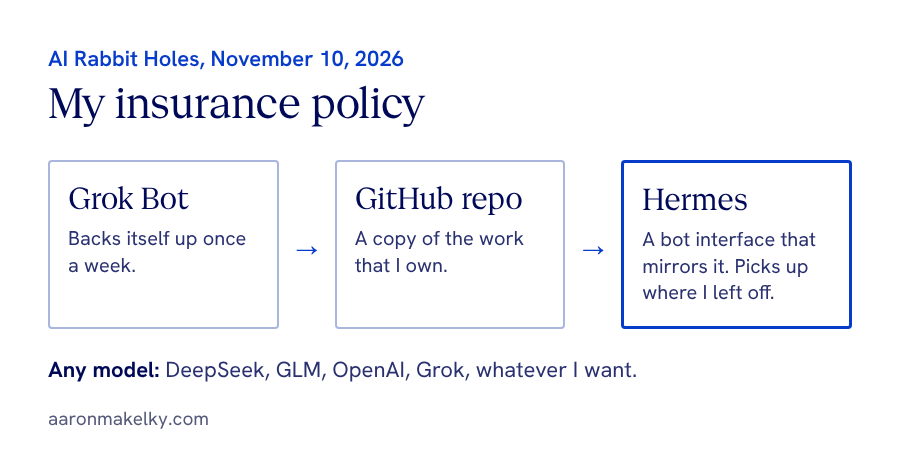
It's a good time to use GitHub and Google Drive, and to make some skills that live outside of your app so you can point any agent or tool at them. Make it portable. If you don't know how, ask your model. More on that in your AI app should not own your work.
For most people, on a free Meta Muse plan, you can do all the personal assistant work you'd ever want, and the model is plenty good enough.
The next day, Ryan and I went through the software we pay for, outside of AI.
If you want help picking a plan or making your setup portable, book a 30-minute call, or follow me on X at @theaaron.