Field notes
The Lovable tax, and the $10 a year website stack I use instead
· 17 min read
AI Rabbit Holes · Lovable · Vibe Coding · AI Website Builders · Claude Code · Cloudflare · GitHub
People can argue the word scam. But you at least must admit you pay a tax if you use a tool like Lovable, versus building it the way Ryan showed on the show.
I talked through Ryan's viral Lovable post and the website stack we both use with Ryan Doser on AI Rabbit Holes, recorded October 15, 2026. Then I brought a deck of this week's AI hype, and we called each one: chase it or ignore it. Our episodes go up on Ryan's YouTube channel. The one right before this, GitHub for marketers, is the perfect connection to this one.
Ryan's problem with Lovable
Ryan was on the couch when he saw a Lovable ad, the kind that says one prompt gets you a magical website. His question was, what about the results? Does it rank? Does it get organic traffic? Does it show up in LLM citations? He posted that Lovable, and most AI website builders like Base44, Replit, and Framer, are a scam. He admits scam might be a little harsh.
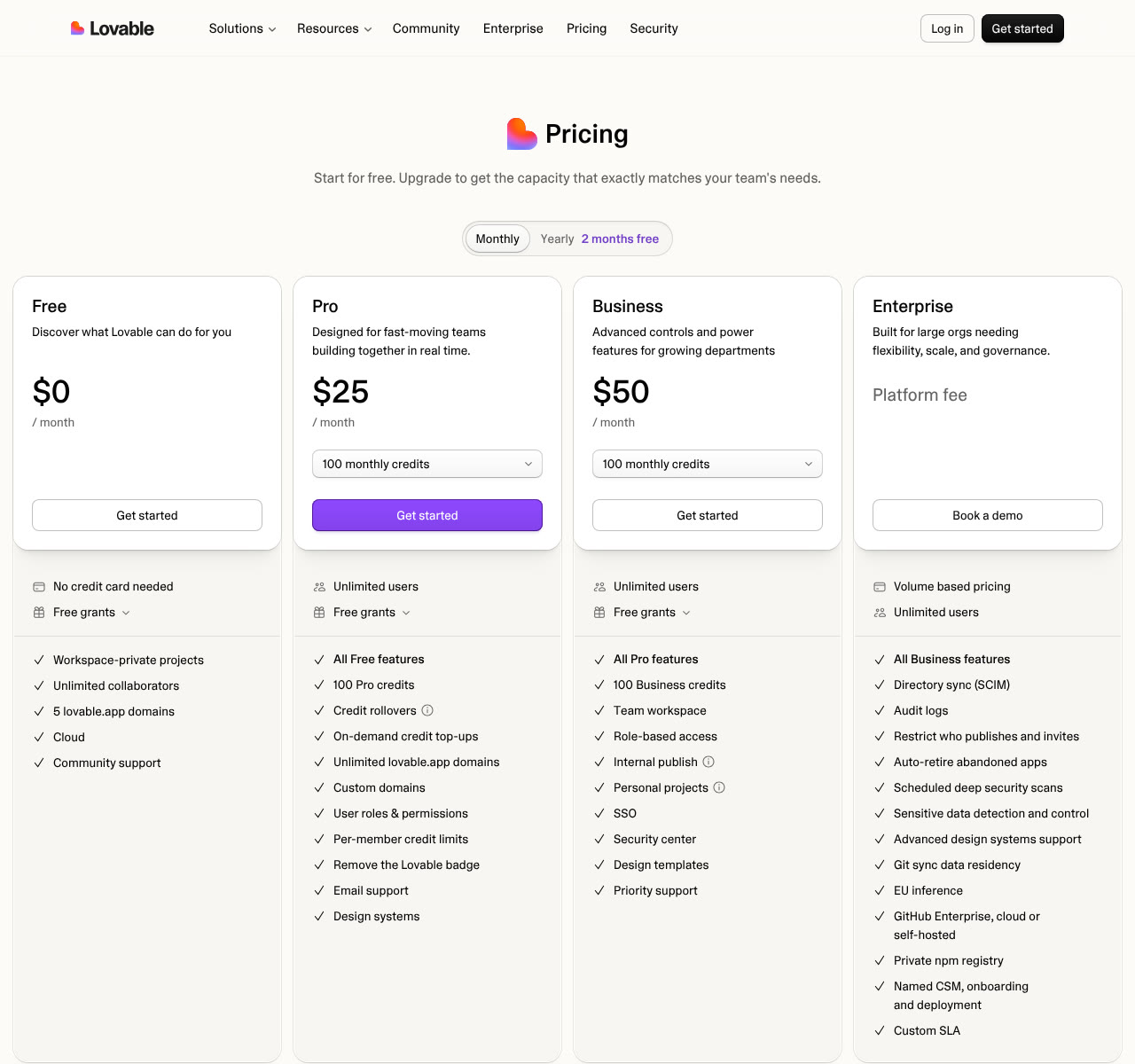
His argument is that people pay a premium for less usage and don't realize it. Lovable Pro is $25 a month for 100 credits, and nobody knows what a credit is worth or which model runs behind it. Ryan also pointed to a study by SEO expert Kasra Dash, from their episode together, that found Lovable websites tanked people's SEO. And you're handcuffed to the ecosystem. Yes, you can export, but does the average person who goes down the Lovable rabbit hole know how to move it to GitHub and deploy it on Cloudflare or Vercel?
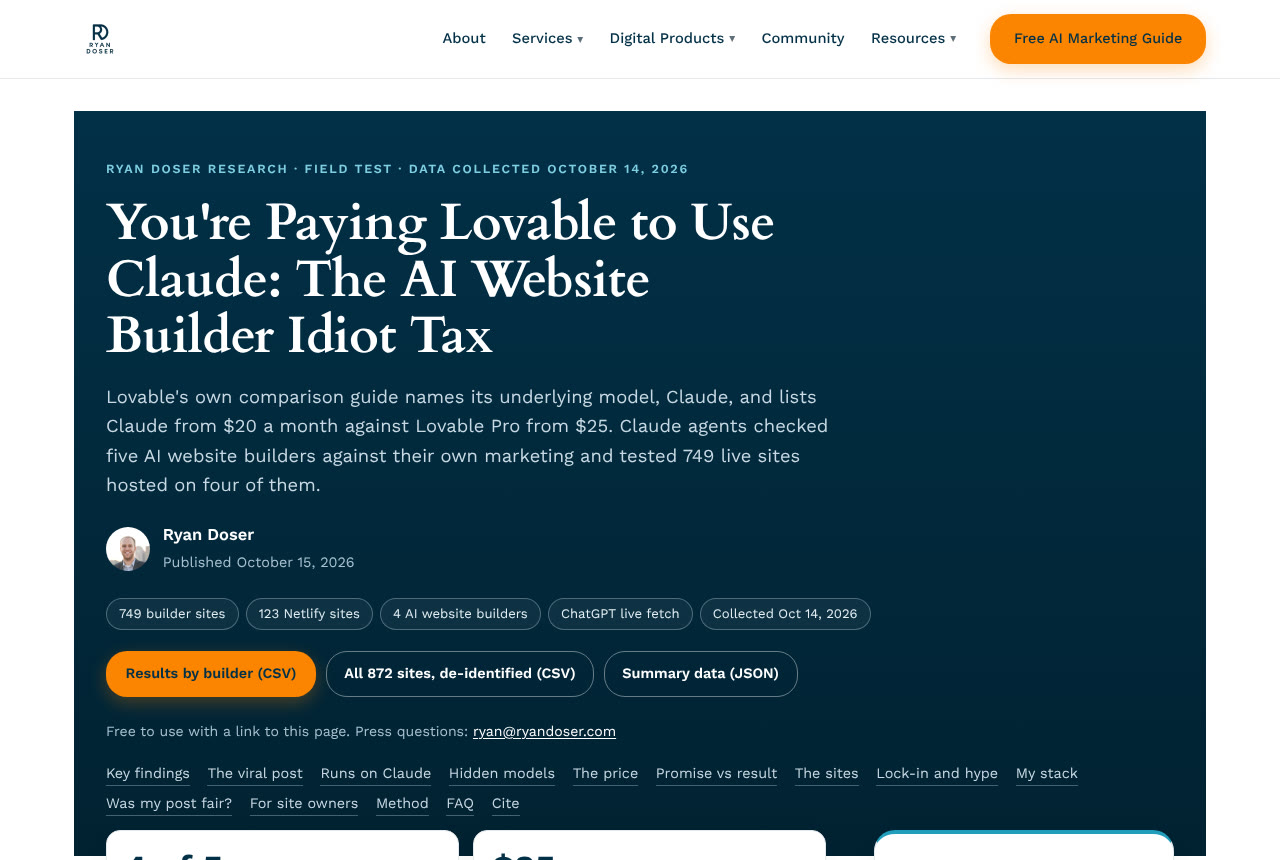
After the show, Ryan went deeper on his research page. Lovable's own comparison guide names Claude as its underlying model, and Lovable doesn't let you pick the model. So you pay Lovable $25 a month for Pro when Claude starts at $20.
My Lovable story
In the summer of 2025, I used Lovable. I was part of a group they gave access to, we had a competition, and it was my entry-level vibe coding experience. But I had a friend who was a guy kind of like Ryan, just a few steps ahead of me, and he would always message me: dude, just use Claude Code, what are you doing?
At first I thought he was just being funny and teasing me. Then I realized he was saying, no, Aaron, where's the back end of your website? I had to go make a Supabase account. Then he's like, where's the code at? I don't know, it's in Lovable. You don't have it on GitHub? What are you doing? He basically told me the playbook: you now know you want to make websites, and that should be your sign to get off of Lovable and stop paying them.
Pretty soon I had a GitHub repo with my code. I deployed my site on Cloudflare, and I canceled my account.
So I'm not here to say you're an idiot if you use it. I think it's more like this: you're an idiot if this is something you want to make a good product out of, and you just keep using a pre-made vibe coding platform.
Because the kind of person who pays for Lovable also has a ChatGPT or a Claude subscription. You're already paying for an AI tool that makes the other one unnecessary now. You should learn how to use that thing to build the site, and have the code in your GitHub, deployed where you want, with the back end where you want. "I do vibe coding in Lovable, but my other stuff I do in Claude" just doesn't make any sense.
The stack Ryan and I both use
Ryan's stack starts with Claude Code and Codex, which he runs in VS Code. You could use the terminal or the Claude or ChatGPT desktop apps instead. GitHub stores the files, free. Cloudflare deploys them and holds the domains. Ryan calls it the most underrated free tool in this AI era, and he uses Vercel for a few clients. The Astro web framework, which Cloudflare owns, gives the coding agent a structure to build on. He's not married to Astro, though. If something better comes out tomorrow, bye bye Astro.
His how-to is about that simple: copy the Astro URL into Claude or ChatGPT, say use the Astro web framework and connect to my GitHub repository, then connect GitHub to Cloudflare. It takes a little bit to build it locally and deploy it, but it's not that hard.
What's funny is we arrived at that independently. I didn't ask Ryan how he builds and deploys websites and copy him, or vice versa. Our paths converged on their own.
I pay five bucks a month for Cloudflare. I could probably do ninety-nine percent of what I'm doing on a free plan, but I buy domains there, I host sites, I use workers, and I use storage for stuff. It's one of those deals: get it and you'll find ways to use it. GitHub is the same. Even on a free plan, once you set it up and start using it, you'll be like, wow, it can do this and this and this, and it becomes really valuable.
The biggest thing is you want control over that. If you canceled Claude Code and went to Codex, it wouldn't matter to your websites at all. You connect with a different coding agent and say, here's my GitHub repo, let's add a landing page and put it on the sitemap. Boom, done. You can't do that with a Lovable or a Bolt or a Replit.
Does the website get you leads?
The thing Lovable doesn't tell you: OK, the website's up, and it looks cool, and it's fast, and it's easy. No one's arguing with those outputs. But does it work? No one builds a website to look at it on their own screen and say, that looks cool. It's to get leads, to get people to download your product or book meetings. There's some purpose behind it, and that's where the vibe coding tools fall short.
It takes a couple of months to see the results. If you trust a Lovable type tool with that, you're missing out on what you'd get if you just had GitHub connected to Cloudflare connected to your AI tool of choice and said, go, this is what I want.
Ryan rebuilt ryandoser.com on this stack at the end of February or beginning of March, off WordPress, with a website builder skill, and he can make sitewide updates in seconds now. Since then the site has led to clients, affiliate deals, email subscribers, and over $50,000 in digital product sales.
His favorite example is Des Moines Septic, a site for a septic business that doesn't exist. It's 100% AI, built on the same stack, and when he searched septic tank pumping Des Moines on the show, it ranked number one, ahead of every real septic company in town. It gets three to five septic leads a week. Calls run through CallRail, which forwards them to a real septic company and announces "new lead from Des Moines Septic" first. Some people call that rank and rent, and Ryan has a whole video on it. He's also built a gutter cleaning site for friends who run an exterior cleaning business, and a new basement flooding site after all the rain in Des Moines.

Ryan's sites all look alike, and he says no one cares. They care whether it ranks, whether the call button works, and whether someone picks up the phone.
You're having a bad week if you had to Google septic pumping and basement flooding close enough together to notice how similar the websites look. And the funny thing is it's a repeatable motion. Once you have something that works, do it in a different city or a different industry. The groundwork is already laid. You're just changing the window dressing on it.
What a site like that costs: about $10 a year
For you to stand up those websites, the only cost is the AI subscription you already have. You buy a domain, and most .coms I get are seven to ten bucks a year. You're on a free GitHub plan. There's your code. Astro's just a framework. It doesn't cost anything. And you're deploying it on a free Cloudflare plan.
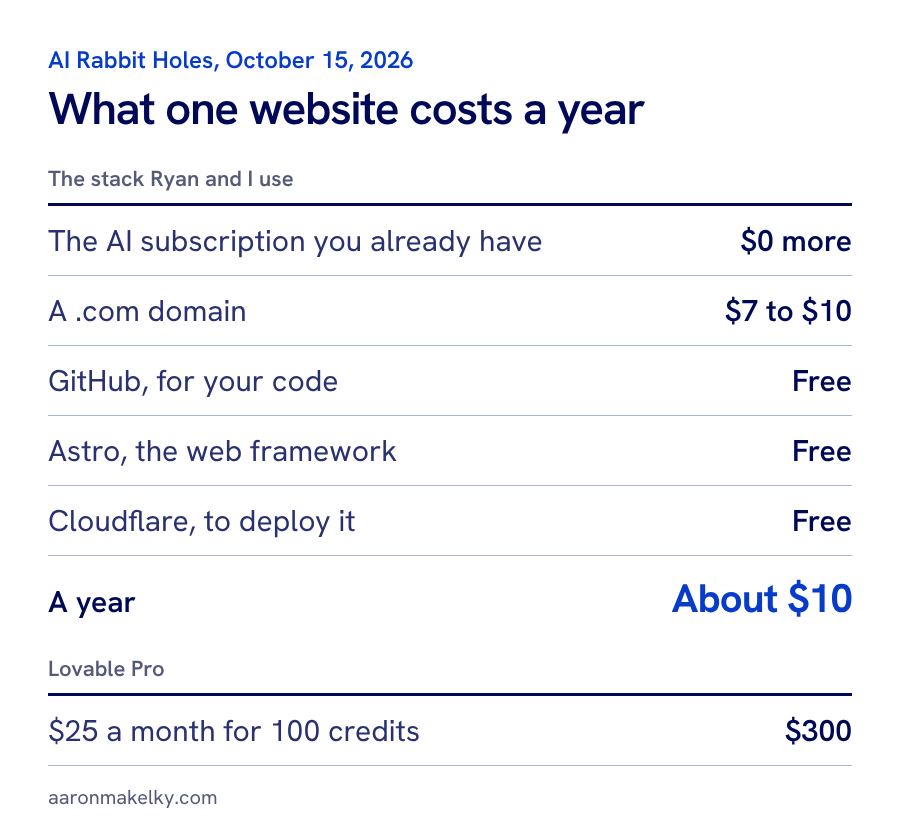
So for $10 a year, say you got $10 a lead for gutter cleaning and you only got 10 of them. That's still a ten to one ROI on what you invested. And if you really wanted to beef it up, you could make that a thousand to one if that was your focus.
Learn GitHub sooner than I did
When I was using those tools, I thought people were being jerks when they'd say stuff like what Ryan and I are saying now. But I've learned this: the sooner you cut your teeth on it, the better. Just get into GitHub. If you haven't seen our GitHub for marketers episode, go back and watch it. The sooner you learn how to use GitHub, the less reliant you are on all these other subscriptions. Maybe not now, but you're going to get to that point. So start building in there, start learning, and ask for help from people like Ryan who know how to do it. Your life gets easier.
Chase it or ignore it
For the second half, I pulled up a deck of what was new or getting hype in my world this week, and we called each one: chase it or ignore it. No one decided ahead of time. It was a real-time reaction.
Gemini 4 Argon: ignore it
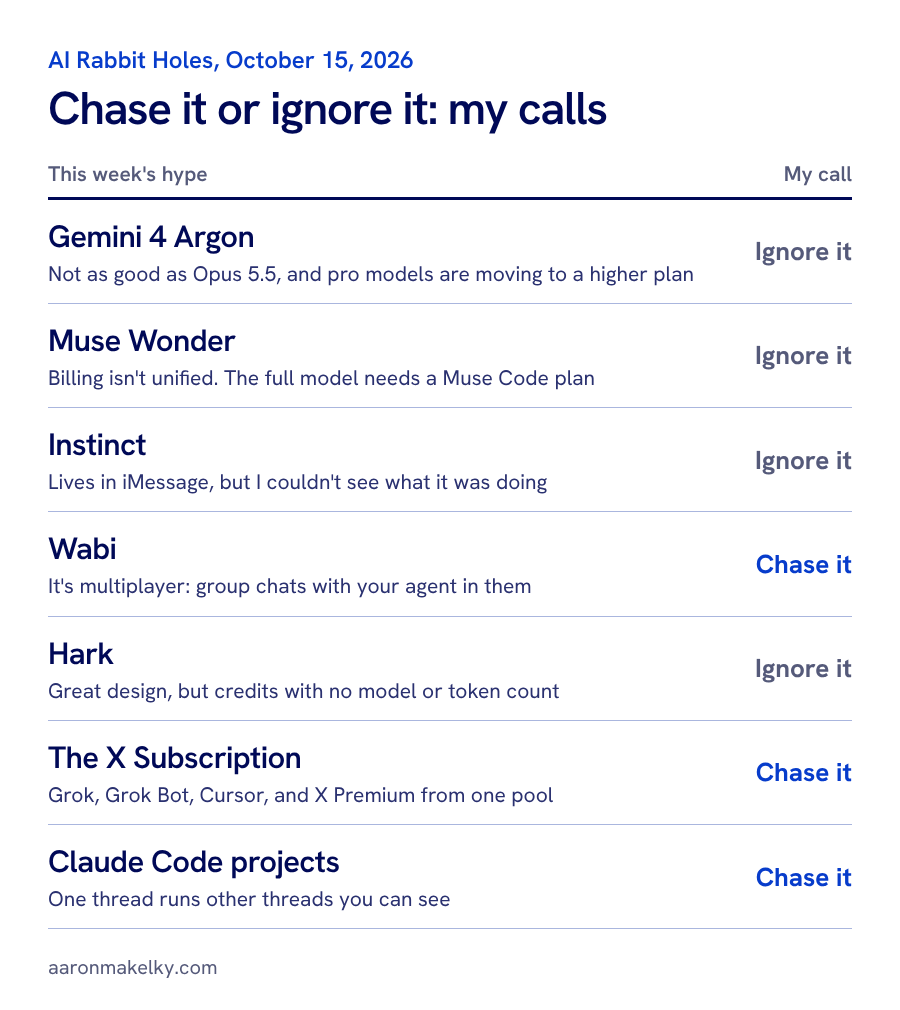
Gemini has its first new pro model in months, Gemini 4 Argon. My biggest reason to ignore it is the billing. I'm paying for Gemini Pro, and they're saying you'll have to go up to Ultra to use pro models starting next month. Right now I have access, and I've played with it. Here's my standard: it's not as good as Opus 5.5. Is it better than what they had? Of course. It's priced about the same as the OpenAI frontier models, and the output is about the same. But if it's not better than what you're already using, why are you wasting your time? Don't cancel Claude or OpenAI for it.
Ryan hasn't tried it. He's so far in the weeds on Claude Code and Codex that he sticks with frontier OpenAI and Anthropic models he knows move the needle. His wish for Google: you have YouTube, Google Images, and every website in your search engine. How do you not have the best AI image model, video model, and personal assistant?
Hard agree. The biggest one is the personal assistant. All of our email and docs and calendar live in Google. How do you not have your version of OpenClaw, Hermes, or Grok Bot going? They have Gemini Spark, and it's terrible.
Muse Wonder: ignore it
Meta has new Muse Wonder models, including a heavy version. I'm saying ignore it because their billing is not unified yet. You have to be on a Muse Code plan to get the full Muse Wonder model, and it doesn't make sense that they have a subscription called Meta One that doesn't include it. It's not that the model isn't good enough. Their pricing is weird. Unless you're all in on Meta models and Meta Muse runs your business, I'd one hundred percent ignore this. And again, it's not better than Opus 5.5. That's the standard everything has to compete with for now.
Ryan asked what I mean by better, since better is subjective. I use mine for design, visual tasks, video editing, and copywriting. Since I've been using Opus 5.5 daily, about two weeks now, I've realized how poor the OpenAI models were at those tasks, and the Grok models too. I'm on a Max plan and I'm not running out of usage. Why would I chase something that's not better and is going to cost more time and money to figure out? I'm not a developer, so I'm not vibe coding complex web apps or iPhone apps. But for anything visual, creative, and complex, I haven't found a single model that can touch what Opus 5.5 can do.
Ryan uses Opus 5.5 as his daily driver for everything too. When he tests a new model, he pulls it through OpenRouter in VS Code instead of getting an API key from Google or Meta.
Instinct: ignore it
Instinct is the iMessage-only agent. Ignore it, for people like Ryan and me. The only reason to chase it is if you don't want an app. With Grok Bot, you need an app. This lives in your iMessage, and it's just like texting a contact.
I got early access about two months ago, when it was new, and I was very sketched out by the privacy. I couldn't see what it was doing, I don't know what model it runs on, and I don't know where its virtual machine is. It felt dark and sketchy. They raised a billion dollars just last week, so it's blowing up again. Unless you really want something that lives only in iMessage and is super simple, I'd tell people to ignore it.
Ryan asked how a startup like that raises a billion dollars. It's the reach. Instinct doesn't cost anything, so investors' money has been subsidizing every token people's agents run, and they get to show how fast they're growing and how many signups they get. This happens all the time. The one before them was Poke, which got acquired by Cognition, the company that bought Windsurf. I'm on a one dollar a month Poke plan, and I was like, how could any company sustain this once the investor funding goes away? You couldn't even cover the token cost. It's kind of like Lovable. They're probably better at marketing than they are at building the actual product.
I think they're betting on the future. Right now, somewhere between one and three percent of Americans pay for personal AI tools like a ChatGPT plan or an agent, and they figure one day it'll be ninety-nine percent. The problem is when you leave the Twitterverse and YouTube and walk down Main Street in Des Moines, Iowa, or Casper, Wyoming, and ask people if they pay for AI tools, they're like, why would I? History will be the judge of that one.
Ryan's take on anything that cheap or free: it's data. You know who understands the power of the data? Marketers. Once you see what big SaaS companies can do with pixels and cookies and search history and location permissions, you get why a lot of them want an app on your phone. They want to know where you eat lunch on a Tuesday. And you're probably going to give a free app permission to see that.
Wabi: chase it
Wabi is an AI messenger that runs errands and builds mini apps in your chats. I'm still early on it, and it's invite only. The only reason I know it exists is I follow a really good designer who went to work there. Not sponsored, and I don't make any money from it.
I'm constantly trying these tools, and my wife is sitting next to me on the couch going, what good is that? Why do you need an eighth personal assistant app? Fair point. Here's what's different with this one: you can do group chats with other people and bring your agent in.
I have a trip coming up, and I need to schedule who's picking up the kids which day and what activities they have. I usually do all that myself. I write it up in a document and give it to whoever's helping. With Wabi, I invited my wife, she signed up, and now we have a group chat in the app with my agent in it. You set permissions for whether it can talk about your calendar, your email, and your personal stuff in that chat. It also builds apps for you inside the app. It'll say, hey, I see you have a trip, I built an app to track your flights, your rental car, and where you're going each day.
So I'm intrigued, and I'm chasing it. The best thing about it is it's multiplayer, and I haven't seen any others yet that are.
Hark: ignore it
Hark came out last week, a free assistant that uses its own computer to finish tasks for you. Ryan's question was how it's any different from Grok Bot or ChatGPT Dots. I'm saying ignore it, even though it does some things really well. It doesn't do anything unique enough to be worth it.
The design is cool, though. Here's one feature I like: in the chat, when there's a verb like email Ryan, you can tap the word email and it just does the task. You don't have to open a connector, mention Gmail, and say, hey, send this email. It nudges you toward taking actions, and it's really well designed.
The problem is the same one you have with Lovable. They say you get so many usage credits. OK, what model? How many tokens? How many more do I get on the $20 plan versus the $60 plan? It doesn't say. For now it's free, and that's how they get people in. And Ryan's going to say it again: it's the data.
The X Subscription: chase it
For most people, if you're already paying for Grok, Grok Bot, Cursor, or even just a paid X plan, chase the new X Subscription. That goes all the way down to the $8 a month one, which I was on for about two years because I just hate ads.
Before, you had a pool of usage for Grok. I was paying for the highest tier and barely touching it. Then you had a separate pool for Grok Bot, which I use the heck out of, and it's really valuable to me. Then you had usage on Cursor, where I use about half. They were all different products with different plans. Now they're smashing them together. One monthly subscription gets you Grok, Grok Bot, Cursor, and the paid version of X so you don't see ads, and it all comes from one pool. If you're using Grok models in Cursor and Grok Bot, they drain the same token pool. More on that in how to get more Grok Bot usage.
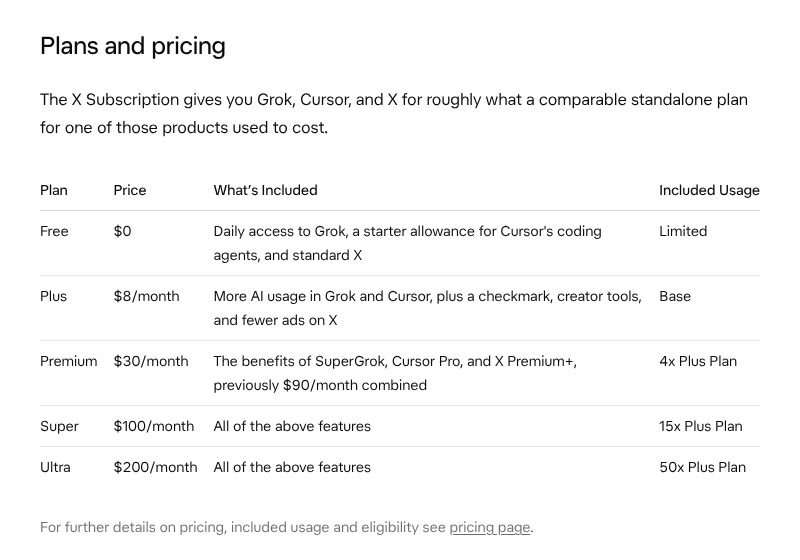
The trick is Cursor with third-party models. They were subsidizing access to OpenAI and Claude models. You used to get $400 a month on the Cursor Ultra plan, and now you get $100 a month, which is not great. If you switch to the new X Subscription, none of that is subsidized. It's dollar for dollar against your usage. But I question why you're using Cursor if you like third-party models. Just get a subscription from Anthropic or OpenAI. Other than that, it's worth chasing for most people.
Ryan thinks Grok Bot is the best personal assistant out right now. His gripe with ChatGPT Dots is that it's one ongoing chat with one dot, while Grok Bot lets you orchestrate different agents that each master one thing.
One more thing that endears me to Grok Bot as the everyday work agent: the voice mode. It was already good, and a new Grok voice model came out yesterday. This morning I was cooking, using my hands, going to the stove, and just doing a voice chat with my chief of staff. It works so well, and it answers quickly. You can even say okay bye and it hangs up on you, so it's hands-free to end a call. If you haven't used voice mode in Grok Bot, try it with the new model.
Claude Code projects: chase it
Last one. Claude had a new feature in beta last week, and I think everybody who signed up has access now: Claude Code projects. If you're doing complex stuff where you'd use subagents, you should absolutely chase this. I have been.
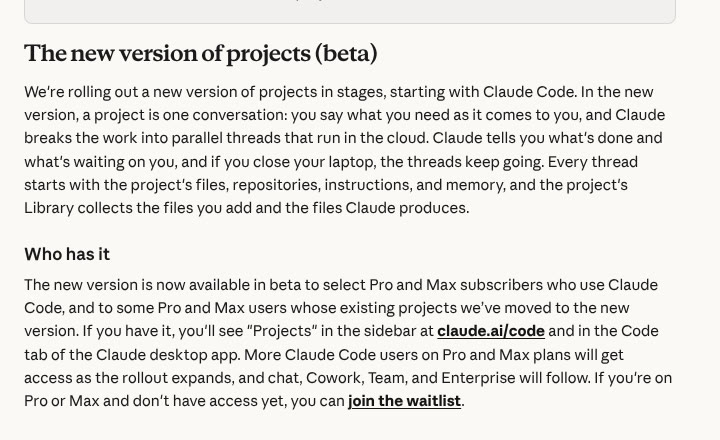
It basically gives you one thread that runs other threads. I made the Claude slide in my deck that way, because we're dogfooding our own advice here. I voice prompted it: here are the slides I need, use my style. It ran three agents. In Claude Code those would be kind of hidden, and you can't see what they're doing. Here, you get them in the sidebar.
It used to be chat, Cowork, and code, and now chat and Cowork finally got combined. Good move there. In the code setup you make a project. You have a master thread, which I run with Opus, and your prompt kicks off other threads beside it. Say you're building a website and you need some design, some copywriting, some code, and some images. You get those threads on the side, but you don't have to look at them. You just say start this, finish that, sync it with GitHub. It tells you this thread needs your help, this one's blocked, this one needs a permission. It's just a better interface than subagents running in the background.
What's confusing is that in chat, you can still have projects, and those are different. They're just a bundle of chats. I wish they'd come up with a different name for it.
Ryan isn't leaving VS Code. His slash commands, like his YouTube video packaging one, already spin up subagents for titles, research, and the thumbnail. He asked if Claude Code projects is the same thing with a nicer interface. That's exactly what it is: a cleaner view, with a sidebar to see those threads when you want to.
Have your own benchmark
I think everybody needs their own standard to test or compare the new thing to. When it comes to models, if it can't beat Opus 5.5 for the efficiency and the visual stuff I use it for, I'm not going to chase it. I also love the idea of having your own benchmarks. Run it against a real task or workflow of yours, versus what some grifter on X says: it's over, because this thing is here, even though they're getting paid to post about it.
Ryan's last word went back to Lovable: open your mind a little bit. "I'm not a developer, I'm not technical, so I have to use Lovable" isn't true. GitHub, Cloudflare, Astro, Claude Code, and Codex aren't that difficult. If you don't know the answer to something, voice dump into your AI tool of choice, and it'll walk you through it step by step in plain English. It'll even create the GitHub repo for you.
If you want help moving your site off a vibe coding platform, book a 30-minute call with me. I'm also @theaaron on X, where I post multiple times a day.